
Agentic AI is scaling in the enterprise. Business events is not even at the starting line.
McKinsey's new global survey and our own 12-month benchmark study measure different industries. Put side by side, they tell one story: adoption is not the hard part anymore. What you do with it is. And our industry is behind on more than one front.
By Tracy Judge, CEO & Founder, Soundings

McKinsey just published The State of AI in 2026: On the Road to ROI. We are comparing it to the Soundings 12-Month Benchmark Report, released earlier this summer. Read together, the two studies show where we are keeping pace and where we are not. In some places, we’re not even close.
I’ve compared the two, theme by theme, below.
Everyone is adopting. Fewer are scaling agents.
McKinsey finds AI use is now mainstream across industries. Eighty-nine percent of organizations use it in at least one function, and 44 percent report scaling it across the enterprise, up from 38 percent last year. Inside that, agentic AI, an advanced form of artificial intelligence that can autonomously achieve specific goals with minimal human supervision, is the next frontier. Forty percent of large enterprises now report scaling AI agents, up from 27 percent last year. Nearly a third of organizations have decided against buying software because they can build it in-house with agentic coding tools instead.
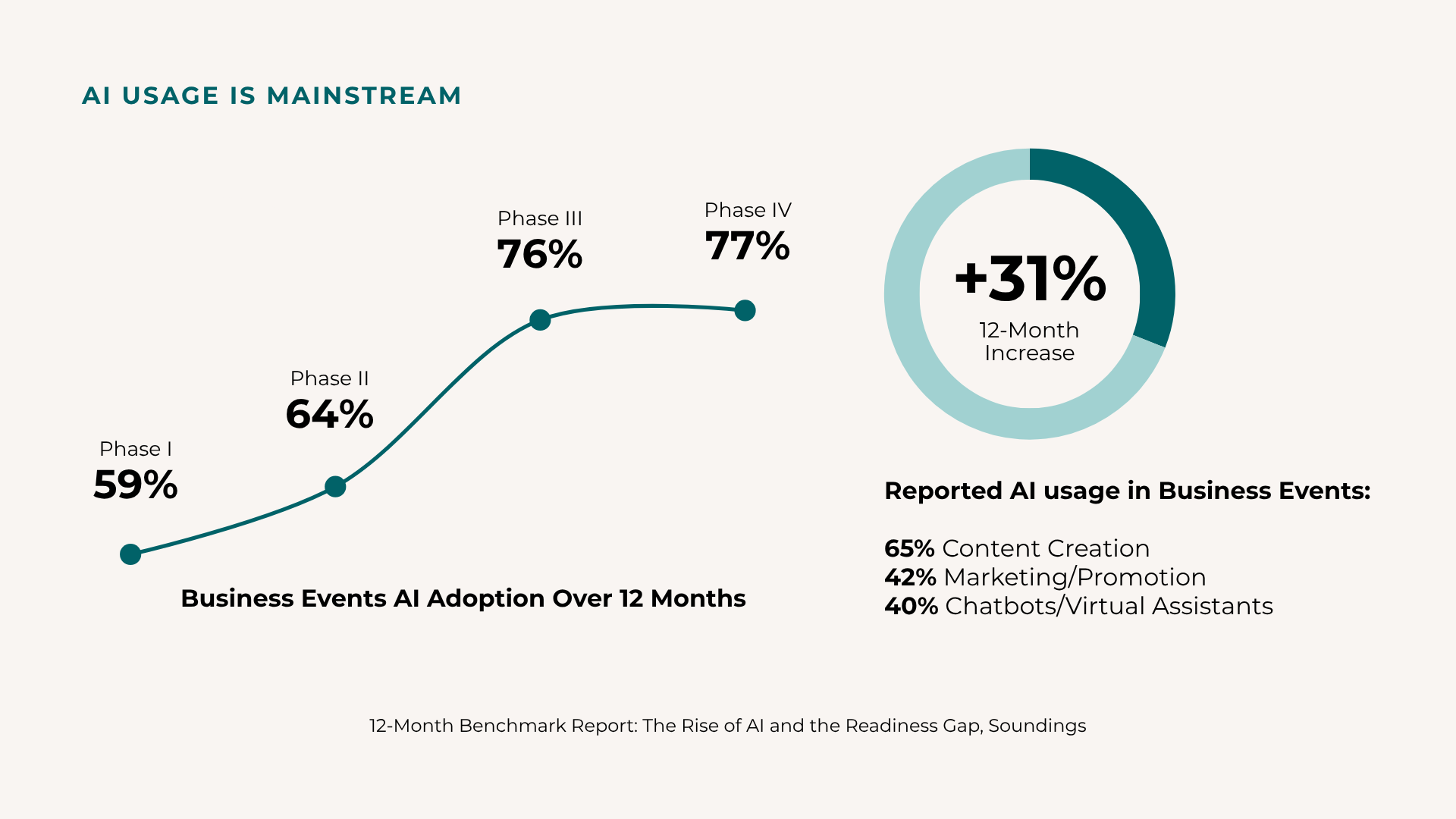
Our own research shows business events matching the surface number. Usage climbed from 59 percent to 77 percent over four survey phases, a real and fast increase. But look at what that usage is made of: Sixty-five percent of it is content creation; forty-two percent is marketing and promotion; agentic tools, or coding agents, basically anything that acts autonomously across a workflow, barely register.
The enterprise conversation has moved to which functions get agents. We have not entered that conversation yet.
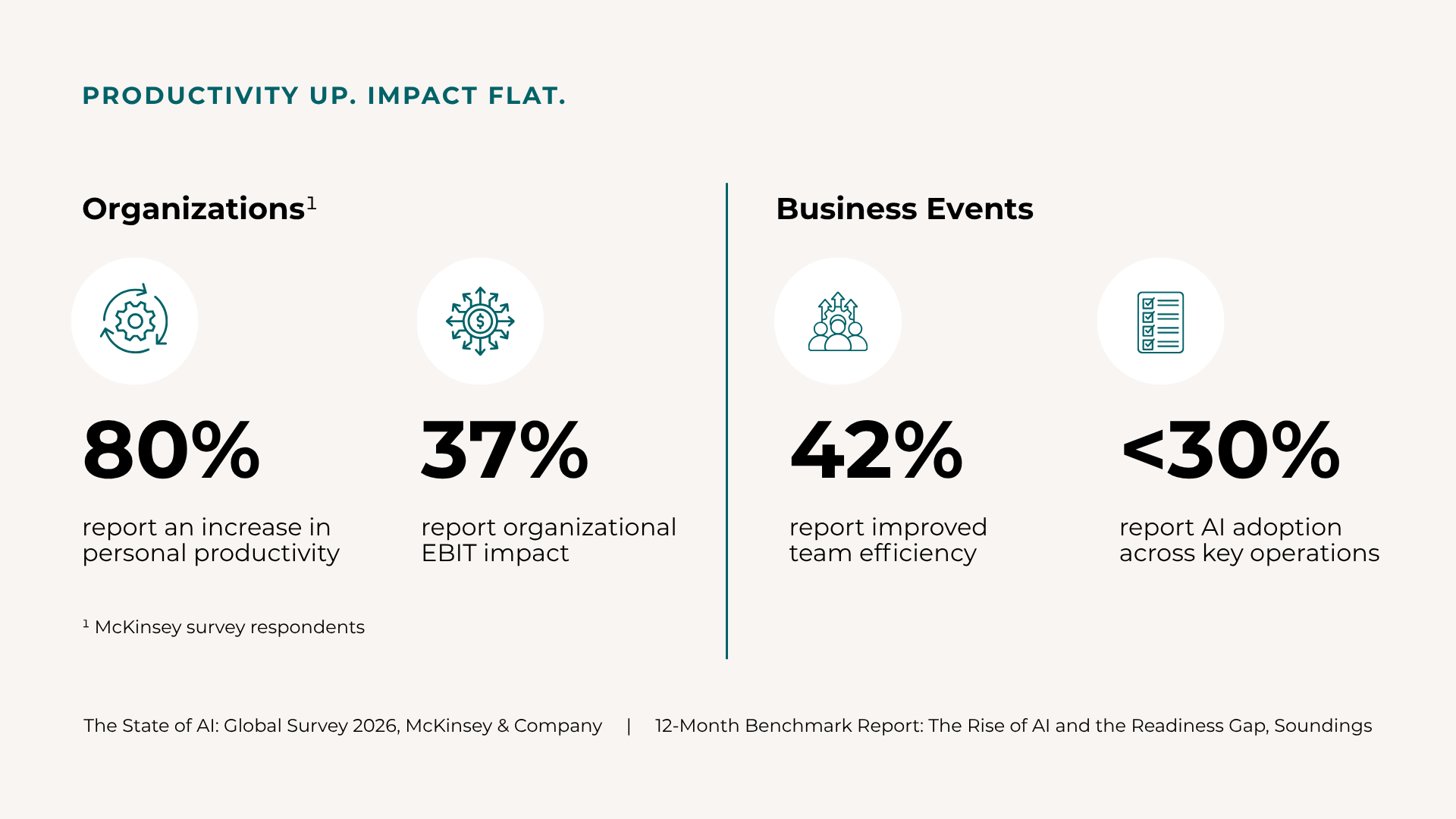
Individual productivity up, organizational impact flat. Same story, twice over.
McKinsey's clearest finding is a gap. Eighty percent of respondents say AI has made them personally more productive. Half say it helps them make better decisions. But only 37 percent of organizations report any EBIT impact from AI, essentially flat with last year. People are getting faster, but companies are not yet reaping the financial benefit.
The business events industry shows an identical trend. Forty-two percent say AI has improved team efficiency. But operational uses like logistics, attendee personalization, and budget tracking all sit under 30 percent, far behind content and marketing. The gains are real and personal, but they have not moved into how our organizations run.
What separates high performers, and where we sit on that scale
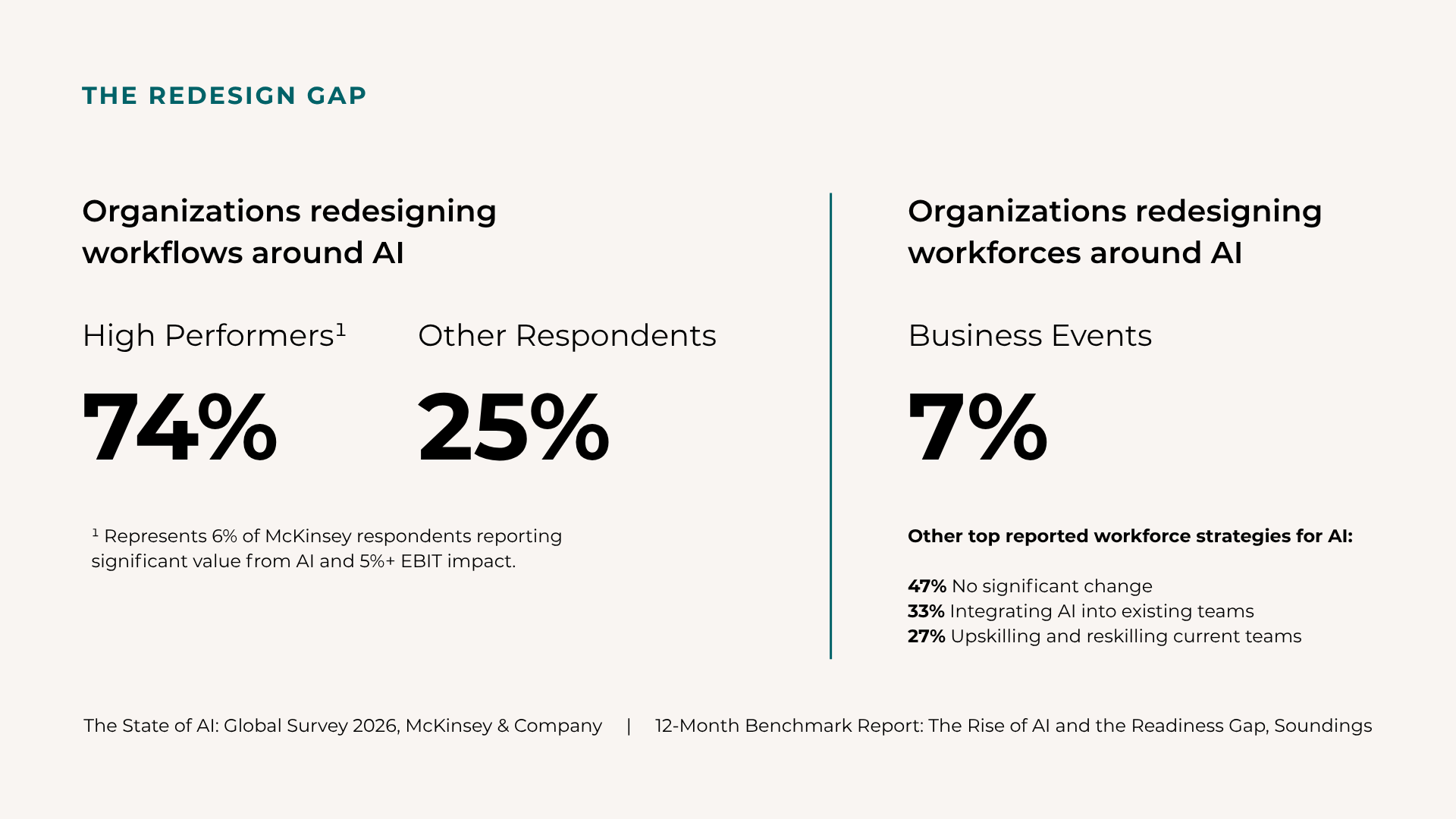
McKinsey isolates a small group, about 6 percent of respondents, who report real financial impact from AI. What sets them apart is not budget, though they do spend more. It is workflow redesign. Nearly three-quarters of high performers have fundamentally redesigned their workflows around AI, up from 55 percent last year. Among everyone else, only a quarter have done the same. High performers are 3.3 times more likely to plan a full business transformation with AI, and their senior leaders are twice as likely to visibly back the effort.
Now, let’s take a look at what business events leaders will prioritize as AI and automation become more prevalent. According to our research, the largest response, 47 percent, was “no significant change” to workforce strategies. Only 27 percent are actively upskilling. Just 7 percent are redesigning teams around a blend of full-time and freelance talent. If McKinsey's high performers sit at 74 percent workflow redesign and the enterprise average sits at 25 percent, the gap is already significant. But with almost half our industry making no change at all, we are not simply trailing ‘high performers.’ We’re falling far below the industry average.
The investment gap: enterprises are funding what they know is missing
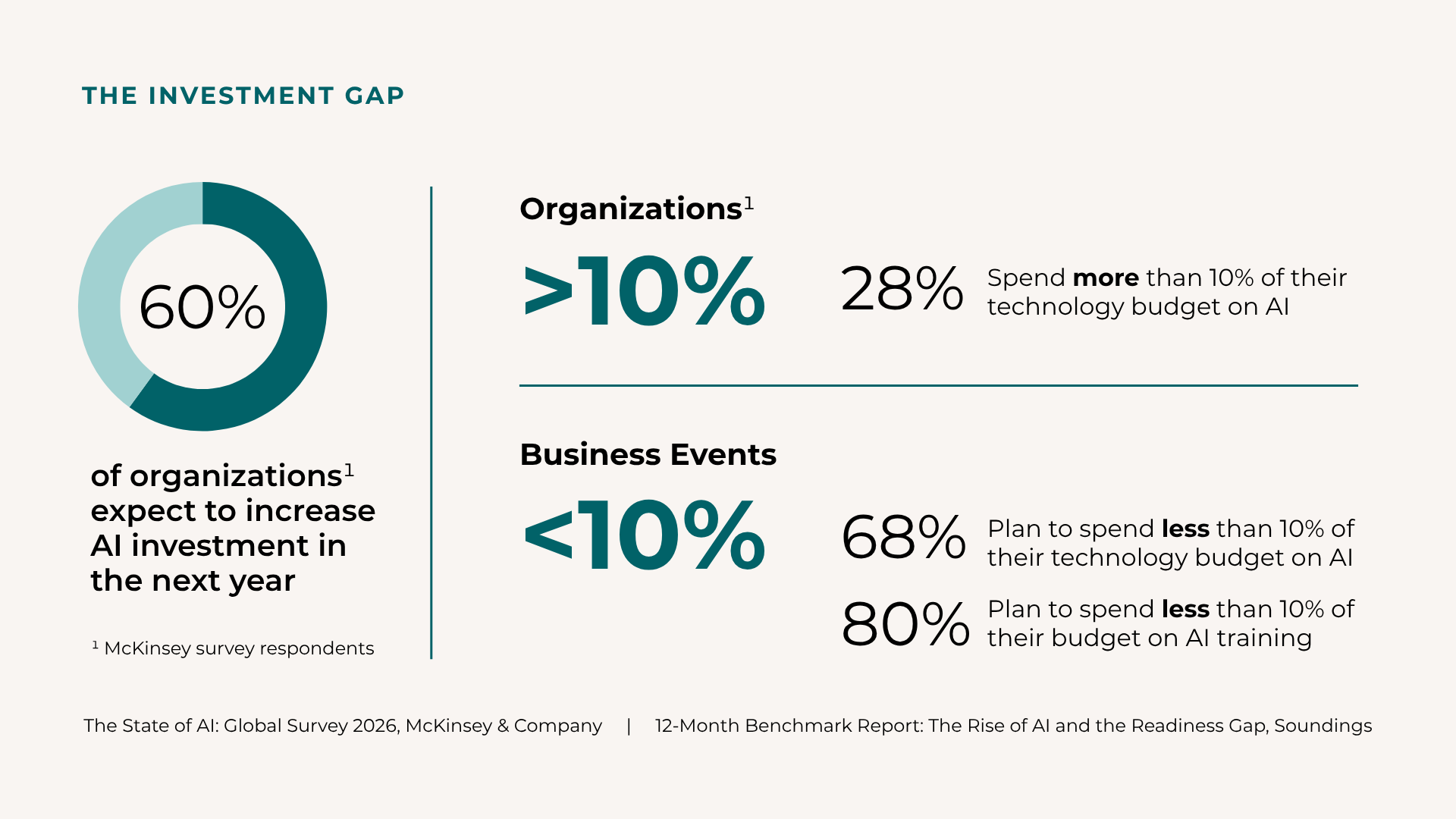
McKinsey finds real investment being made. Sixty percent of enterprises expect to increase AI investment next year, and 28 percent already spend more than 10 percent of their tech budget on AI. High performers go further still: they are twice as likely to spend over 15 percent of budget on AI, and more than half plan to increase spend by 10 percent or more.
The business events industry has not made the same commitment. More than 68 percent of us plan to keep AI tech spend under 10 percent of budget. More than 80 percent plan to keep AI training spend under 10 percent as well. Enterprises, including the average ones, are treating this as a funding priority. We are still treating it as optional.
Build versus buy: a shift we have not had to reckon with yet
One McKinsey finding has no equivalent in our data, and it is worth flagging precisely because we have not caught up to the conversation. Nearly a third of enterprises report skipping a software purchase because agentic coding tools let them build the functionality in-house. High performers are twice as likely to do this. For an industry that runs on manual, repetitive event operations, often bought as point solutions from vendors, this is a shift worth watching before it arrives rather than after. The RFP process many of us run today may not survive the next two years unchanged.
Workforce fear versus realities
McKinsey's respondents increasingly expect AI to shrink headcount. Thirty-nine percent expect declines next year, up from 32 percent last year. But only 14 percent report an actual decline over the past year, less than half of what was predicted. Two-thirds report little or no change in headcount at all, and just 13 percent say AI makes them personally anxious about their career.
Our industry tells a related but different story. The fear is not job loss. It is stasis. Forty-seven percent of us report no change to workforce strategy at all, even as usage climbed 31 percent around us. Enterprises are bracing for a change that mostly is not happening. We are not bracing for anything, and that is its own risk.
What I think we should do in business events:
Move past content and marketing. Enterprise agentic adoption is concentrated in IT, software engineering, and knowledge management. Ours is concentrated in content and marketing. Pick one operational workflow (logistics, attendee management, budget tracking), and start there. See what efficiencies can be created by implementing AI.
Redesign the workflow, not just the tool. The gap between McKinsey's high performers and everyone else is not budget. It is whether they rebuilt how work happens. We are at 7 percent redesign. That is the number we need to move.
Fund it like it matters. Allocating less than 10 percent of budgets for AI training and tools, compared to what enterprises (let alone high performers) are spending, simply isn’t enough to enact real change. Treat this as a real line item, not a pilot.
Watch build-versus-buy before it lands here. Agentic coding tools are already changing how enterprises buy software. We run on vendor point solutions. That collision is coming.
Replace inertia with a decision. Whether the decision is to invest, redesign, or wait deliberately, make it a decision. Forty-seven percent of us reporting “no change” is not a strategy. It is the absence of one.
We are not behind because people are not trying. Our usage numbers prove otherwise. We are behind because we have not made the moves that separate high performers from everyone else in McKinsey's data, and in some areas, like agentic tools and AI investment, we have not started making them at all. That gap is closable. The next 12 months are where it either closes or hardens.
Soundings Elevate, our suite of talent development services, helps organizations close this exact gap. If you are in that 47 percent with no strategy yet, let's talk. Request a proposal for our AI Learning Lab for Teams, and together, we will build your 90-day AI roadmap for lasting transformation in an AI-empowered workforce.