
From Tool to Trajectory: Why Your Tech Stack Is a Career Stack
An Offstage with Soundings® recap of my session at Cvent CONNECT
By Tracy Judge, Founder & CEO, Soundings
I've used Cvent for most of my career. Long before I founded Soundings, it was the platform I built registration sites in, the tool I turned to for attendee data, the system that quietly ran in the background of almost every event I touched. And for a long time, I thought of it exactly the way most people do: as software.
It took me years to realize it was actually one of the best career development tools I had.
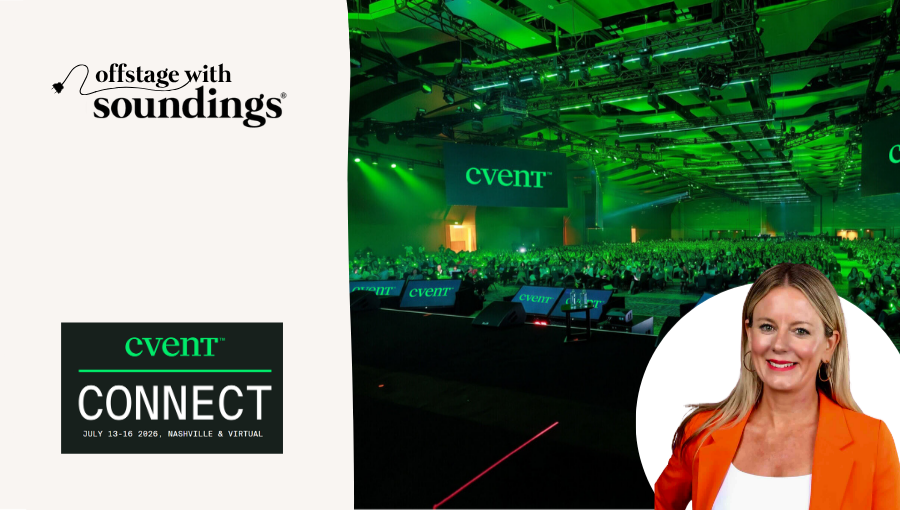
That's the idea I brought onstage at Cvent CONNECT for my session, From Tool to Trajectory: Elevating Your Career with Cvent. I wasn't there to walk through another feature release. I was there to make the case that the experience professionals are building inside Cvent every day is already shaping the career they'll have tomorrow, whether they're paying attention to it or not.
The Skills That Won't Be Automated
The World Economic Forum estimates that 86% of businesses will be transformed by AI and information processing technologies by 2030, with 39% of today's workforce needing new skills and 58% of job skills expected to change. Those numbers should get every event professional's attention, not because technology is coming for our jobs, but because it's raising the bar on what we're expected to contribute.
The tasks most exposed to automation are operational and repetitive. The capabilities that remain, critical thinking, creativity, strategic decision making, leadership, adaptability, influence, curiosity, are the ones that don't show up on a certification. They show upin how you use the tools you already have.
Nobody Buys Software. They Buy Outcomes.
Organizations don't invest in a platform like Cvent because they want technology. They invest in it because they want better business outcomes: more efficiency, more revenue, better attendee experiences, less risk, programs that scale, smarter decisions.
The platform enables all of that. It doesn't create any of it. People do. Every successful implementation depends on someone who knows how to configure the technology, redesign the process, read the data, bring stakeholders along, and deliver the experience. Those are business skills. They just happen to live inside a Cvent login.
Careers Aren't Ladders Anymore. They're Modular.
This is the shift I most wanted attendees to leave with: stop defining yourself by which Cvent products you know and start defining yourself by the business capabilities you're building through them.
In the session, we mapped six capabilities that show up again and again in leadership roles across meetings and events:
Operations — building scalable processes, managing projects, driving execution
Customer Experience — designing attendee journeys, personalizing engagement, balancing efficiency with hospitality
Technology — understanding integrations, automation, and configuration well enough to solve business problems, not just run a report
Data & Insights — moving past what happened into why it happened and what we should do differently
Strategy — connecting events to organizational priorities and measuring business value
Influence — leading change, mentoring, communicating with executives, driving adoption
None of those are reserved for directors. You build them every time you use the platform to solve a real problem. And that's the modular career, in practice: instead of climbing one fixed ladder, you're assembling a set of transferable capabilities, one role and one project at a time, that you can carry into whatever's next.
Look at the Job You Want, Then Look at the Tool You're Already Using
The exercise that landed hardest in the room was simple. Attendees rated how much each of the six capabilities was currently part of their role. Then, after we unpacked what each one actually looks like day to day, they rated themselves again.
Almost everyone moved. Some realized they were already doing more strategic, data-driven, or influence-heavy work than they'd given themselves credit for. Others saw exactly where the gap was: maybe they were strong in operations but had never touched the data side, or vice versa.
That's the exercise I'd ask every event professional reading this to try, on their own time, with their own next role in mind: pick the job you want two steps from now, then look at what you're doing in Cvent today. Which project could you volunteer for that builds the missing capability? Which report could you learn to build yourself instead of requesting it? Which integration could you finally understand end to end? The platform is already sitting there. The question is whether you're using it as a career resource or just a task list.
This Is the Conversation I Want to Keep Having
Career growth in this industry has never been about one big promotion - It's about intentionally stacking capabilities until the next opportunity looks obvious in hindsight. I want to keep pulling that thread, with event professionals building their own trajectory, and with organizations thinking seriously about how their platforms and programs double as talent development. If that's a conversation you or your team want to keep having, I'd love to hear from you.
To everyone who joined me at Cvent CONNECT: thank you for showing up ready to think about your career, not just your task list. Keep asking what you want to solve next, not just what title you want next.
I would love for you to share your comments, learnings, and progress below!
Tracy Judge, MS, CMP CEO & Founder, Soundings